


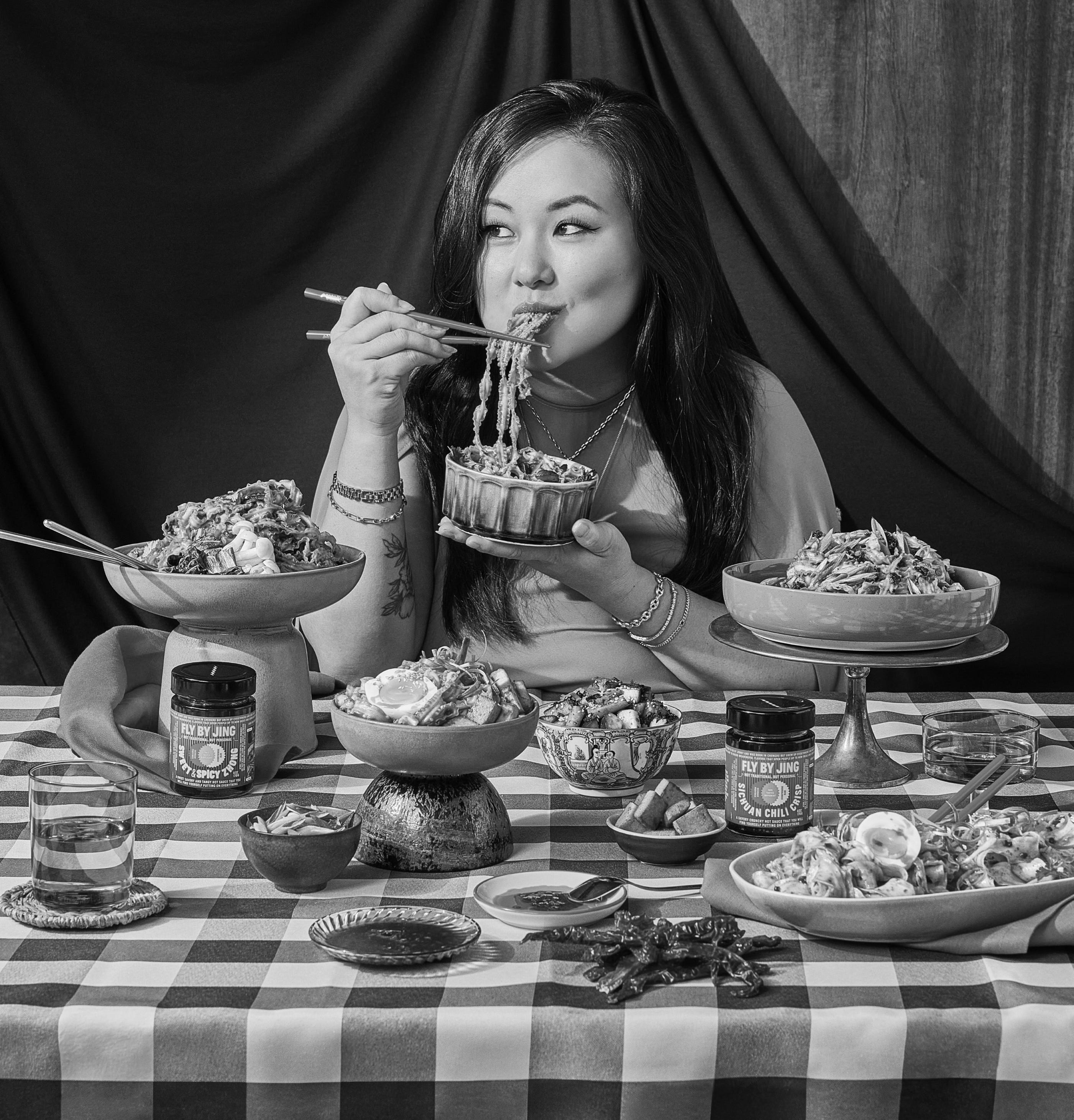
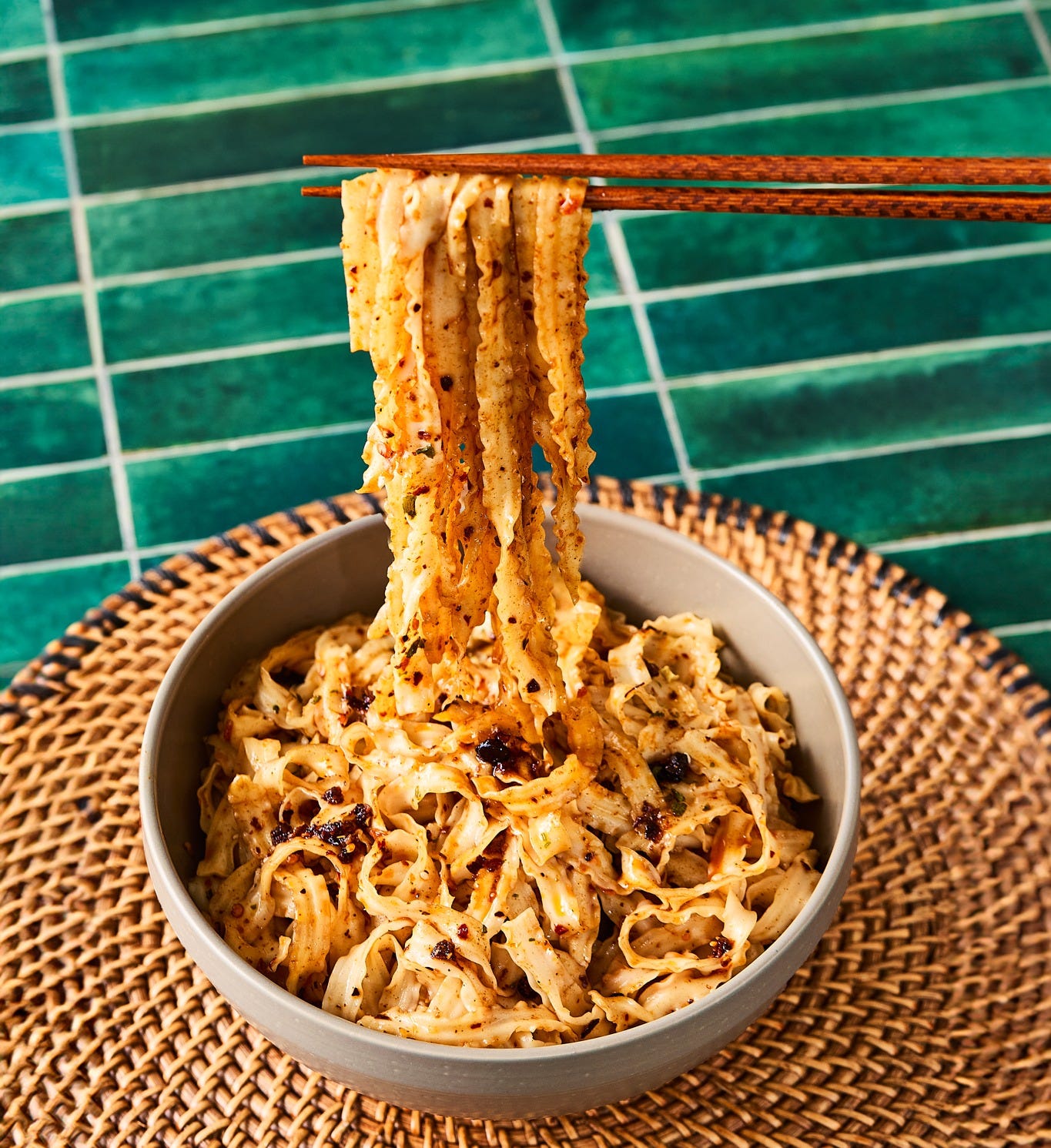
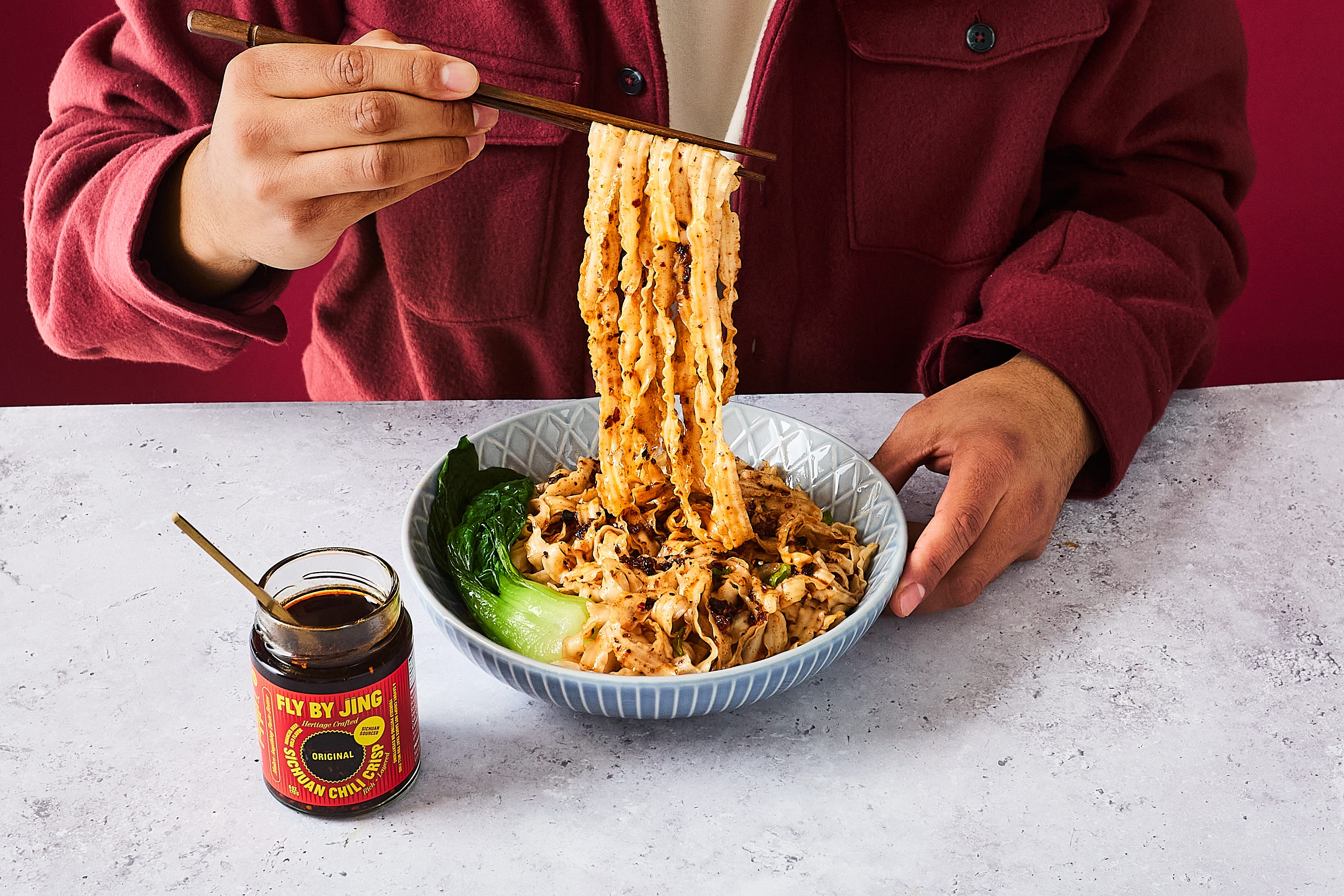
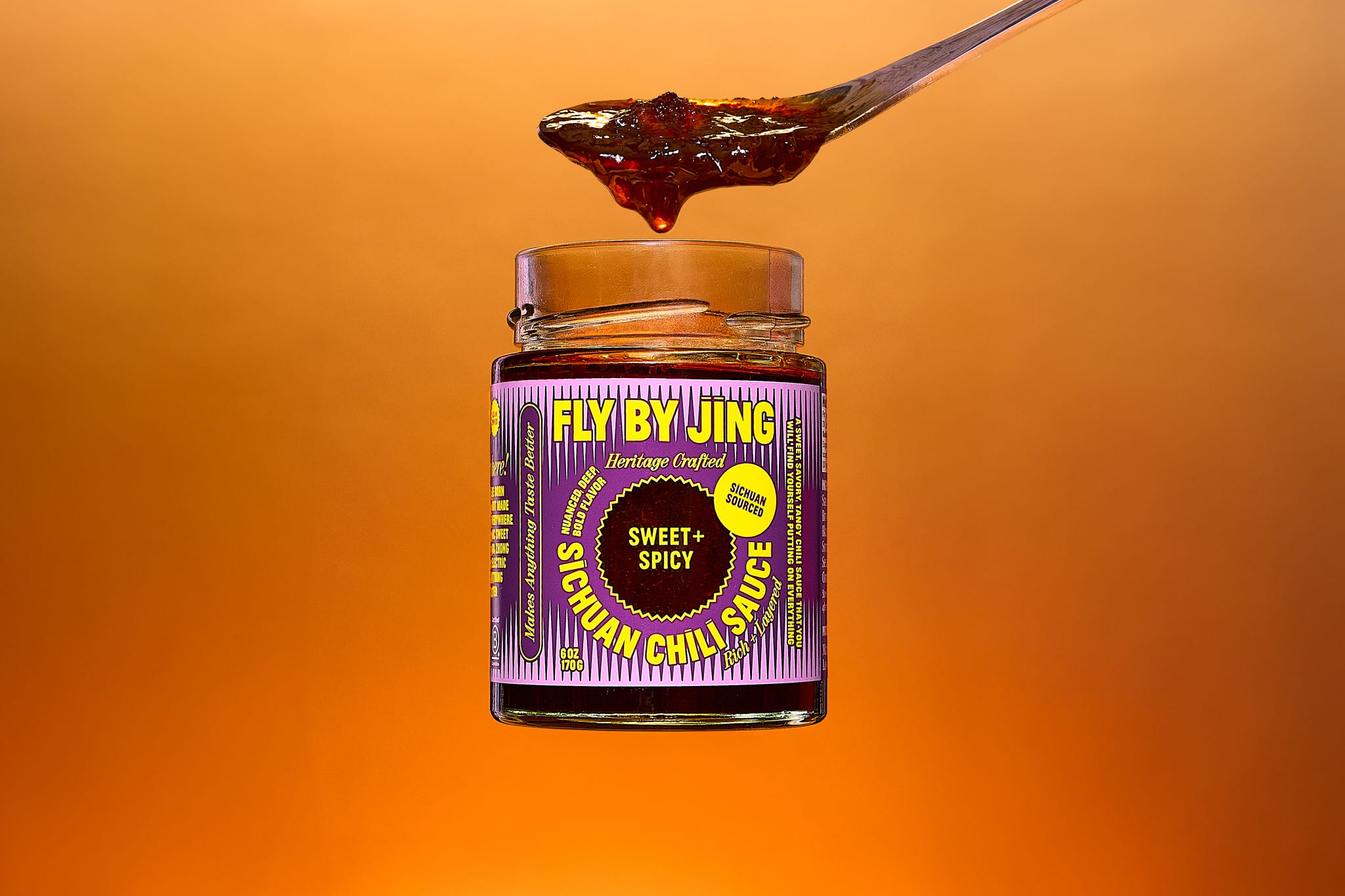
Jing Gao is the founder and CEO of Fly by Jing, a company selling non-traditional, but very personal chili crisps and noodles rooted in Sichuan ingredients and cuisine. Started in 2018, her business really took off in the early Covid years when everyone was cooking at home. She started with a chili crisp and has expanded to a variety of sauces and noodles, as well as dried peppers, tools, and other ingredients. Fly by Jing’s Sweet & Spicy Sichuan Chili Sauce has had a spot in my fridge off-and-on for years, and their noodles have been a great addition to my pantry for quick lunches. Jing and I chatted about her deeply personal interpretation of Sichuan cuisine, changing perceptions of Chinese food, and her brand being an on-ramp to new flavors.
Brianna Plaza: Tell me a bit about your background and why you founded Fly by Jing.
Jing Gao: I was born in Chengdu, which is the capital city of Sichuan, which is the food capital of China. It’s one of the great cuisines in China. I grew up moving around a lot; we lived in Europe and Canada. Growing up, I was always the odd one out, especially in European countries, and I felt very disconnected from my cultural heritage and identity.
In my 20s, I had a job opportunity that brought me to China, and that’s where I started to peel back the layers and search for my identity and found some answers through the food culture. It was a very personal journey to get into food. The more I dug into it, the more I realized how much depth this 5,000 year culinary heritage has that isn’t being translated in the west.
I quit my job in tech and founded a restaurant in Shanghai that was championing modern Chinese flavors in a fast casual format. I also had a blog about Chinese food culture which really allowed me to go deep into the history of and shine a more respectful light on Chinese food.
I spent some time in my hometown and studied with this incredible master chef and learned so much from him about ingredients of the region. They’re so high-quality and so rare and hard to access, even within China. There are negative biases in the west that Chinese food is cheap and unhealthy, and it’s almost self-perpetuating because Chinese people are being told that no one is going to pay over a few dollars.
Being able to use these incredible ingredients and the pursuit of self expression is how Fly by Jing was born. Jing is my birth name and Fly restaurants are these hole in the wall spots that are so delicious and a cherished concept in my hometown. They attract people from all over and they’re a great socioeconomic equalizer. I was really inspired by that, so I started a series of underground supper clubs called Fly by Jing, which lead me to popups in Shanghai and all over the world.
These dinners would allow me to share these flavors with a wider audience, but I had to bring all the ingredients with me in my suitcase. You can’t just replace these specific ingredients with something else. People really responded to these flavors that I love and grew up with, and there just wasn’t a lot of access to them outside China. So I started to think about how to make them more accessible, and I started to bottle some of these sauces that were part of my recipes. It would help me save time when I got to a new country because I was carrying a chili crisp instead of the raw ingredients, and I realized that these are actually self-stable products. Maybe I could jar it and share it more. It was really driven by this desire to share flavors and change the narrative around Chinese food.
Fly by Jing is my own personal lens of what Chinese food is. Sharing a very personal slice of what that means to me and hopefully creating the space to allow more people to be able to share their unique stories. Chinese people are not a monolith, and there are so many different voices and each one deserves a place.
Brianna Plaza: How do you find your sourcing partners?
Jing Gao: When I was studying with that chef, we literally would just go and visit places, and that’s how you build relationships. You’re not just going to the grocery store to buy ingredients, you have to go and meet people.
The Sichuan pepper we use is grown in the mountains four hours from the city. We’d have to go there every August because the harvest happens once a year, and once it’s sold out, it’s done. The factory where we get our fermented fava beans has commercially available products, but they also have this secret room where they have the stuff that’s been fermented for 5 years and has this magical depth of flavor. So you have to really integrate yourself to where the food comes from and respect the time and effort it takes to cultivate these relationships.
Brianna Plaza: You talked about this notion that Chinese food should be cheap, so how do you think about your higher price point and where you fit into people’s everyday lives?
Jing Gao: I think there’s two parts here. I think the first part is economies of scale. I think most people conceptually understand why McDonald’s has cheap prices vs your local mom and pop store. But when it comes to ethnic cuisine, something gets forgotten. I hear a lot of people say things like, why is this ethnic thing expensive when it’s not “supposed” to be? It’s this pervasive idea that’s gone back for centuries that Chinese immigrants who ran restaurants or laundromats had to adapt and had to be cheap.
There’s also so much nuance which is why there exists this kind of hierarchy of taste, or why we ascribe certain values to different cuisines. French and Japanese are at the top, Chinese and Vietnamese are at the bottom. It has very little to do with the food and everything to do with how we view the people. It’s very intertwined with the immigrant story.
100 years ago, Italian food was also looked down on, and now you can go to a restaurant in New York and a plate of pasta is $40 and people don’t think twice. And yet, you try and charge more than $5 for a plate of noodles and people are up in arms. But the thing is, if it can happen to Italian food, it can also happen to other cuisines. It happens over time as culture shifts and socioeconomic patterns evolve. It’s not overnight.
We’re a small business that doesn’t have the economies of scale of a large corporation. Lao Gan Ma is a brand that is known for Chinese flavors and it’s also a billion-dollar corporation, but it’s very nostalgic and very rooted in emotion for Chinese people. We have a small team and we’re operating in places where these products aren’t traditionally sold and we’re trying to increase access. Being on the shelf of a Target comes at a high cost.
We’re also trying to shift the perception that Chinese food has to be cheap.
Brianna Plaza: There’s also sometimes this obsession with authenticity can be such a loaded word, especially with non-Western food. How do you think about authenticity and your products?
Jing Gao: Authenticity is another very fraught topic which is linked to cost. It has to do with us keeping something in a box and saying it cannot evolve. These are the things we heard when we started Fly by Jing. Everything from I’ve been to China so I know what Chinese food is or This doesn’t taste like what my grandmother used to make. All of these things are attempts to keep Chinese food in a box and to claim ownership over it. We do this with ethnic cuisines but not others.
This is where that authenticity conversation comes in. I think in recent years there’s been a more nuanced conversation around authenticity, especially when it comes to the Asian diaspora. We realized there’s not just one type of Asian. There are so many shades of Asian, so there has to be a nuance in how we talk about our experience and it should be from a personal standpoint, all the way down to our food.
I trained under a Sichuan master chef and use ingredients only from that region. In some ways you could argue that’s more authentic than anything you can find in America because of how rooted in tradition it is. But at the same time, there’s 18 ingredients in our chili crisp and they probably have not been put together in that way before, so it’s my personal lens.
Since we first launched, we’ve had a few iterations on packaging, and we’ve had to adapt in how we tell our story. There was a point when our packaging said, Not Traditional but Personal, but it didn’t say authentic. There was a Venn diagram illustration and in the middle it said, this tastes different.
When I shared this with my family in Sichuan for the first time, they were like this is good but it’s different, I’ve not had something like this before. These products are a unique, personal expression, and that should be allowed.
Brianna Plaza: How do you scale your products and maintain their quality and flavor, especially with so many specific ingredients?
Jing Gao: We have not changed our ingredients or methods since the very first day that we scaled up production. Obviously, cooking something over a stove in a tiny apartment kitchen is not going to translate directly to making something at scale. But the production is still very small batch and it’s a very precise craft.
On the ingredients side of things, we use the same suppliers for our ingredients since day one. These are such high-quality ingredients that I had a hard time finding a manufacturer who would be willing to even take on this project because they were all like, you’re crazy. Why would you put ingredients in there that cost more than the retail price of similar products?
The cost of our materials and labor is more than the retail price of the mass-produced brands. When it comes to Asian ingredients, people seem to have a problem when you charge a higher price point, but we lack the economies of scale to be able to compete with these behemoth companies.
As we scale and get more leverage to be able to negotiate better pricing with our suppliers, we want to make sure that we’re passing that along to the consumer. A few years ago, we implemented a price decrease of 30%. We were able to get those price decreases because of packaging, logistics, and shipping costs without affecting the quality of the ingredients.
We want these flavors to be in as many people’s hands as possible.
Brianna Plaza: So, you’ve got chili crisp, noodles, and hot pot packets. What are you working on next?
Jing Gao: We think about how to bring more people around the table, and how to make it easier and more accessible for people to enjoy these flavors. Because as much as Chili Crisp has crossed over into the mainstream, the majority of Americas still don’t know what it is. We’re in 4,000 Walmart stores but there are places where people are seeing us for the first time. As we grow and innovate, we want to think of ways to make it easier for people to come into the brand, experience these flavors, and create an on-ramp for them to experiment a bit, get their toes wet, and go deeper.
Noodles were a part of that. You might have to explain chili crisp, but you probably don’t have to explain noodles to most people. As we grow, we’re going to keep thinking about we make things to adapt to who we’re serving, which is a modern America person. The modern American is busy and wants to put food on the table in 10-15 minutes. How do we help them do that in a way that is true to us?